


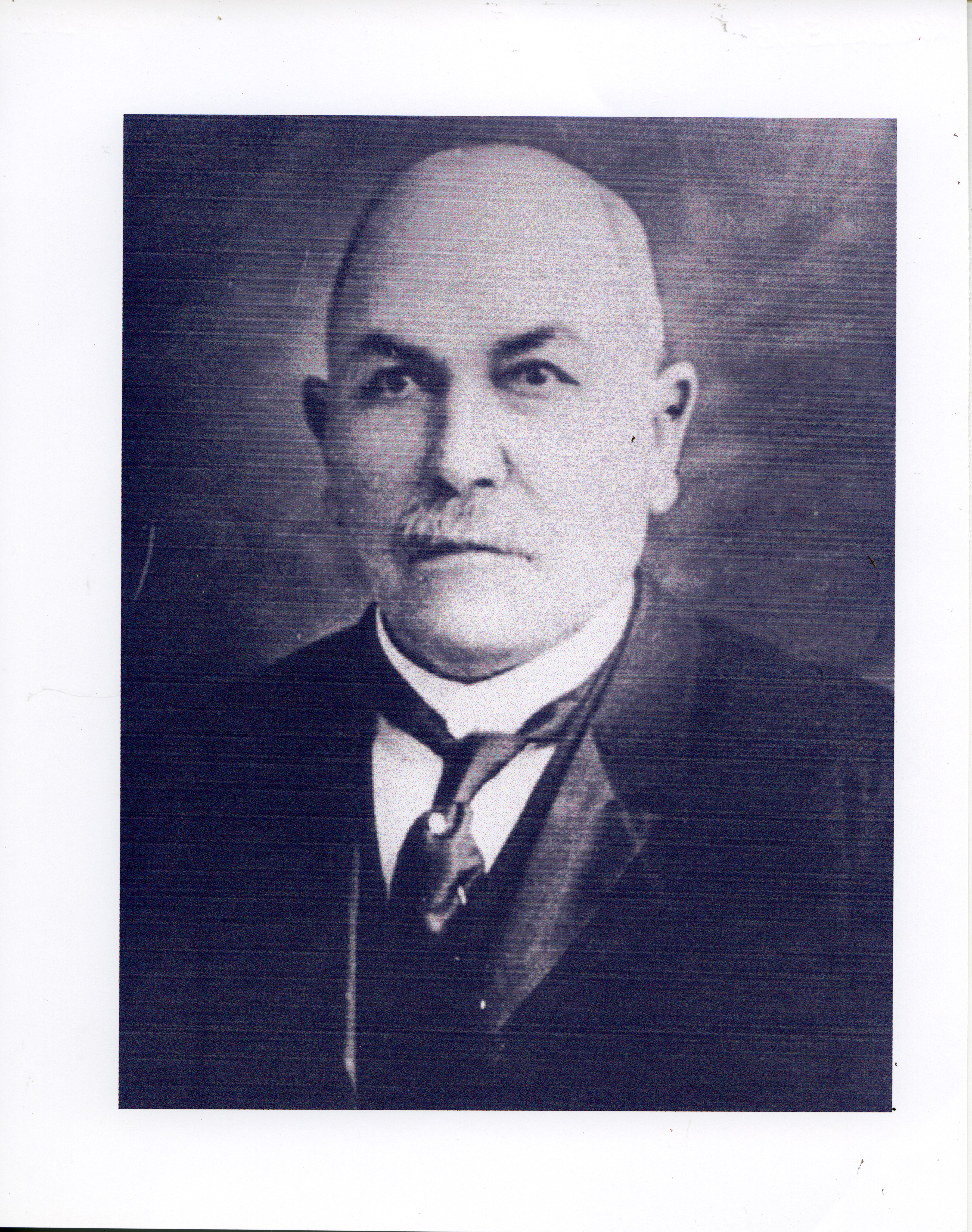
Photo: Thomas Dean, the author’s father, 1929. Sault Ste. Marie Museum PNP.4.272/X2004.3.15.
T. Norman Dean’s “Future of the Sault” was published in nine weekly instalments in Thursday editions of the Sault Daily Star in the spring and early summer of 1909, appearing between the second and seventh pages depending on the week. At the time of its publication, Dean’s father, Thomas Dean, was an incumbent town alderman who would later become mayor of Sault Ste. Marie. This first instalment appeared on page six of the Sault Daily Star on 13 May 1909. Click here to see the original clipping.
Prefatory note
When we consider that the town of Sault Ste. Marie is in the throes of its greatest crisis no apology is needed for my attempt to forecast the future of our town, no defence is required for trying to presage events in the shadowy mists of coming times. Sault Ste. Marie has seen four great epochs of history. First when Du Gaston, the first white man so to do, gazed on the boundless forests and saw the mountains of water tumbling over the rapids struggling madly to reach the calmer waters below. Then the dauntless Frenchman, so the old legend says, fell to his knees and thanked God that he saw such a panorama. In thanks to “le Bon Dieu” he named the rapids St. Marie – that was our beginning. Then in 1889 when the first industry was located at the head of the river by the enterprising citizens of the village of Sault Ste. Marie – that was our impetus. Finally there came the millions of dollars from England and from the United States in industrial activity and investments – that was our first step to advance. And now after a period of six years stagnancy we are on the highway to development – that is our growth. The conservative policy outlined by the Lake Superior Corporation assures us that we are past the boom stage, that the development of the future in a steady growth is assured. Of these four crises this is the greatest. What shall come to pass? What is our fate, our destiny, our future?
For long have I hesitated in trying to write an article of this nature for fear that it might be asked, “How can this future be determined?” There are four ways of looking at a subject of this nature. First as a dreamer who alone with his vagaries considers naught but blindly rushes on – dreaming. His vision is imperfect, his conclusions the result of fancies. Secondly as does the pessimist who looks only on the dark side of everything, whose vision is stunted, dwarfed and deformed; who considers naught that is bright, nothing of the rosy hue of joyful anticipation. Thirdly as does the optimist whose eyes see what is not, whose mind presages conclusions based only on pleasurable premises. His is the hedonistic theory – that of the standard of pleasure. Fourthly as does the logician, trained in observation to regard everything pertinent to the matter in hand, to disregard all that is irrelevant and foreign to his subject, to base no hypothetical and purely speculative conclusions on bases that are not apparent. Of these four only one can be taken; it must be the last if we wish to attain any success.
Such then is my purpose – to attempt to depict the Soo of the future. My deductions are all made from economic facts, logically I think. At the base of the structure I have taken present day facts. As the work grows I have attempted to presage amplified conditions based on the conditions of today. When the whole is completed I wish to present a structure of perfect symmetry, each block in accordance with the lower, not one out of place, not one left out. If in doing this I fail, it is from lack of observation, not from want of careful workmanship, and I shall have attempted to convince the worst pessimist in our midst that, all things being reckoned, Sault Ste. Marie has a wonderful panoramic future rolled up at present but that is gradually being unwrapt by the slow, halting hand of time.
2 of 9: The Economic Results of Our Situation
Lost Texts
Lost Texts is a SooHistory series that republishes old, forgotten texts about Sault Ste. Marie. All posts in this series can be found here. If you like these nuggets of local history, consider subscribing to our mailing list below.