


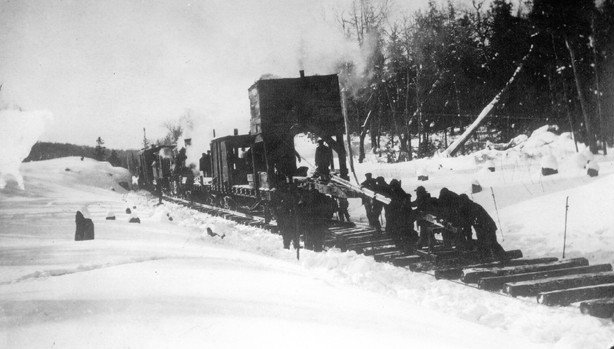
Photo: Laying tracks on the Algoma Central Railway in the wintertime, 1910. Sault Ste. Marie Museum PT.1.16/981.15.10.
Last week we shared the first part (“Prefatory Note”) of T. Norman Dean’s “Future of the Sault,” originally published in nine weekly instalments in the Sault Daily Star in 1909. We continue this week with part two, which appeared on page seven of the Star on 20 May 1909. Click here to see the original clipping. All capitalised spellings are from the original.
The Economic Results of Our Situation
The gods have been good to the Soo in placing her in this unexcelled position that she occupies in the geography of Canada. Situation is the keynote to power. The man of magnetic attraction on the platform draws us, but he has position, situation, that enables him to do so. The man next you placed on the platform might have even greater force. It is situation, so too in things topographical. The situation of Sault Ste. Marie is one great asset, the greatest perhaps. We are a naturally distributing town; this presages railways and waterways; the great undeveloped country to the north of us presupposes abundance of raw materials. To my mind these are all important and worthy of detailed observation.
First, that we are to be the greatest railway centre in Canada seems not at all unlikely. We are at present the terminus of only one railway, the Algoma Central and Hudson Bay. This one railroad, much neglected, tho it is, is going to be the most potent factor in the development of the Soo. Why? Take, I ask you, a map of Canada and see the railways now constructed, and those proposed. We will have north of us, the Canadian Pacific, the Canadian Northern, the Transcontinental and the Hudson Bay railways. The Algoma Central will tap them all. What does this mean? I will tell you what it means. It means that SAULT STE. MARIE IS TO BE THE WHEAT CENTRE OF CANADA.
To-day and for some time back the Canadian Pacific and the Canadian Northern railways have been attempting to get control of the Algoma Central. The purpose is clear. They wish to have a freight line from the west to the great lakes, and want that freight line with an eastern terminus east of Lake Superior. When the C.N.R. has the proposed new line completed it means that via the Soo would mean a saving of 40 hours from Winnipeg via Port Arthur and Lake Superior. To the C.P.R. the control of this A.C.R. and its extension to the main line would mean a saving of 9 hours to Toronto, and a saving of 15 hours to Montreal, besides another outlet to the lakes, thus a possible removal of the annual wheat congestion at the head of the lakes. Besides both companies see the great possibilities of the virgin country to our north. With the building of the Transcontinental and the proposed Canadian Northern, we have three rival roads all striving for the wheat to the seas. With the completion of the Georgian Bay canal there will be an easy accessibility to the sea and a short route for ocean-going boats. This route is one that is inevitable. Then the Algoma Central Railway will be the funnel through which the wheat is poured into the large grain elevators at some point below Lake Superior, and this port must be and will be Sault Ste. Marie. This is only one aspect of the railroad development. There are three others. Railroad development means the expansion of trade, the development of new country and labor increase at the base.
The expansion of trade means much for a town. When the railway facilities are completed a town must increase, that is if the town is the terminal point. There will be an increase in population and thereof in trade, combined with any natural facility for manufacturing the town is bound to be one of the greatest of industrial centres. In this connexion Sault Ste. Marie must be mentioned, with our unexcelled water powers, we are perforce to become a city of industrial importance. The supplies for the railways under construction would be an augmentation to commercial interests.
Railroad development further means development of our country. It is a striking maxim of the study of political economy that development follows the railroad, not railroads the development. This is singularly true of the Algoma Central Railway which is now described as running north from the Soo nowhere. However, the Algoma Central is a paying road. As fast as railroads are built the land adjacent is thrown open for settlement. The lands of the clay belt through which the Algoma Central Railway will pass are unsurpassed for agricultural purposes. Sault Ste. Marie will benefit with the influx of immigrants. The Soo will be the natural outlet and shipping point; the advantage to the Soo of the railway will be invaluable looked at from the standpoint of the settler. But further benefit will be also industrial and commercial. The raw material from future farms will come to the Soo and will be manufactured here. The exploitation of the forests and mines will bring many mills, smelters and refiners to the Soo. We shall rival Pittsburg and Erie. The pall of smoke shall hang over our city, the hum of wheels shall fill our ears. We shall be the smoky city of the north. Our commercial outlook will be widened for as trade advances, so the scope of market is widened. A glorious future truly.
The demand for labor with this increased prosperity shall bring the increase in population. We shall have the solid element of the nation, the “brawny sons of toil” as says Kipling. The population increase means activity. More mouths there will be to feed. This means increase to the wealth of a town for as Karl Marx, the eminent German said: A man is worth $25,000 to his town and country. The increased activity means more trade and that more commerce. Railroad development means truly much for our town. We must advance.
I have already pointed out that the Georgian Bay canal means much for the town. Marine development is consequent. The dry dock is a step towards advance to shipbuilding. With the structural steel plant to be erected in the near future and our valuable timber resources, the Sault is destined to be the great marine town. This means prosperity, wealth and advance. With our position, our situation, we must become the great Canadian port. We shall become the ocean port for sea-going steamers.
The resources of the adjacent country might be made the subject of a lengthy article, but such is not our subject. The virgin forests of New Ontario stand out to-day when those of older countries depleted. We have the timber; the world must look to us for its supply. With the policy of careful reforestation brought in by the Ontario government, our forests will always be a great asset. Our mineral deposits are valuable. The Soo being, as has already being pointed out, the natural port and distributing point the mines will throw their output here. Smelters and concentrators must be erected, and they will be here. With the situation then Sault Ste. Marie must advance, and we are on the horizon of the glorious future.
Lost Texts
Lost Texts is a SooHistory series that republishes old, forgotten texts about Sault Ste. Marie. All posts in this series can be found here. If you like these nuggets of local history, consider subscribing to our mailing list below.